
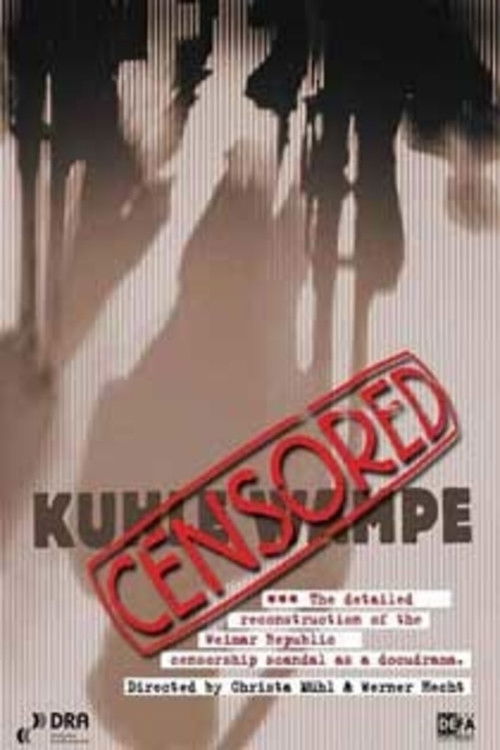
Censored: Kuhle Wampe
Ein Feigenblatt für Kuhle Wampe
Synopsis
A detailed reconstruction of the censorship case against the landmark Weimar-era communist film, Kuhle Wampe, or Who Owns the World? (1932). Directed by Slatan Dudow, the crew and cast included left-wing luminaries, such as playwright Bertolt Brecht, composer Hanns Eisler and balladeer Ernst Busch. The film was the subject of vehement disputes and was banned twice for revolutionary and communist tendencies that were perceived to threaten the state. About 230 meters of the original film fell victim to the censor’s shears. This historic censorship case was argued over the course of three sessions. Censored: Kuhle Wampe re-enacts the censorship hearings, based on original minutes and documents, as well as personal records of the case. In addition to footage from the original film, this docudrama includes original clips of Berlin in the 1920s and '30s and short testimonies, filmed in the 1970s, with some of the actors involved in the original Kuhle Wampe film production.
Top Cast
Explore Star Directory →


Key Information & Fast Facts
- Director
- Christa Mühl, Werner Hecht
- Screenplay & Story
- Werner Hecht, Christa Mühl
- Original Score
- Hans-Dieter Hosalla
- Original Title
- Ein Feigenblatt für Kuhle Wampe
- Country of Origin
- East Germany
- Spoken Languages
- German
- Runtime
- 1h 3m
- Production Studios
- DEFA-Studio für Spielfilme, Fernsehen der DDR
Creative Leadership & Key Crew
Christa Mühl, Werner Hecht
Werner Hecht, Christa Mühl
Hans-Dieter Hosalla
Dieter Körner
Department Leadership Roster
Christa Mühl
Director
Werner Hecht
Director
Dieter Körner
Editor
Werner Hecht
Writer
Christa Mühl
Writer
Production Stills & Gallery
Official cinematic photography and background stills for Censored: Kuhle Wampe.
Featured In Curated Collections
Editorial lists, community rankings, and cinematic collections featuring Censored: Kuhle Wampe.
list6
Similar Titles to Censored: Kuhle Wampe
Movies sharing stylistic DNA, tone, and thematic storytelling

 8.0
 7.2
 8.4
 6.0
 6.0
 7.2
 6.7
 7.1
 5.6
 10.0
 7.4
 6.5

More Like Censored: Kuhle Wampe
Recommended titles matching themes, cast, and genres.









Frequently Asked Questions About Censored: Kuhle Wampe
Quick factual answers about cast, synopsis, director, box office, and release information.
What is Censored: Kuhle Wampe about?
A detailed reconstruction of the censorship case against the landmark Weimar-era communist film, Kuhle Wampe, or Who Owns the World? (1932). Directed by Slatan Dudow, the crew and cast included left-wing luminaries, such as playwright Bertolt Brecht, composer Hanns Eisler and balladeer Ernst Busch. The film was the subject of vehement disputes and was banned twice for revolutionary and communist tendencies that were perceived to threaten the state. About 230 meters of the original film fell victim to the censor’s shears. This historic censorship case was argued over the course of three sessions. Censored: Kuhle Wampe re-enacts the censorship hearings, based on original minutes and documents, as well as personal records of the case. In addition to footage from the original film, this docudrama includes original clips of Berlin in the 1920s and '30s and short testimonies, filmed in the 1970s, with some of the actors involved in the original Kuhle Wampe film production.
Who directed Censored: Kuhle Wampe?
Censored: Kuhle Wampe was directed by Christa Mühl, Werner Hecht.
Who stars in Censored: Kuhle Wampe?
The principal cast of Censored: Kuhle Wampe includes Erwin Geschonneck, Kurt Böwe, Wolfgang Greese, Jürgen Holtz, Peter Kalisch.
When was Censored: Kuhle Wampe released and how long is it?
Censored: Kuhle Wampe was released in 1975 with a total runtime of 1h 3m.
Who composed the musical score for Censored: Kuhle Wampe?
The original motion picture soundtrack for Censored: Kuhle Wampe was composed by Hans-Dieter Hosalla.